Pakistan Reports 9th Polio Case in 2026 as New Infection Emerges in Khyber District
Pakistan has reported another polio case in 2026, raising concerns about the continued circulation of the highly infectious virus in parts of the country. The latest infection was confirmed in Khyber district of Khyber Pakhtunkhwa (KP), taking the nationwide total to nine cases this year.
According to the National Emergency Operations Centre (NEOC), the affected child is a seven-month-old boy from Mastak Union Council in Bara tehsil of Khyber district. The confirmation was announced on Thursday, November 5, highlighting the ongoing challenges faced by Pakistan’s polio eradication programme.
The latest development is particularly concerning because Khyber district has already reported multiple infections this year. Health authorities have again stressed the importance of vaccination, particularly in areas where poliovirus transmission continues despite nationwide immunisation efforts.
Pakistan remains one of the last two countries in the world, alongside Afghanistan, where wild poliovirus is still endemic. Dawn+1
Khyber District Reports Its Third Polio Case in 2026
According to the NEOC, this is the third polio case reported from Khyber district during 2026 and the seventh from Khyber Pakhtunkhwa.
Health authorities have identified genetic links between the poliovirus detected in all three cases from Khyber district and strains circulating in Afghanistan. This suggests continued cross-border transmission between the two neighbouring countries.
Afghanistan has reported 50 polio cases this year, making the situation particularly important for Pakistan’s public health authorities.
The geographical connection between the two countries creates additional challenges for vaccination teams, especially in communities where population movement and limited access to healthcare can make it difficult to ensure that every child receives the required vaccine doses.
Health officials have warned that poliovirus does not recognise international borders. As long as transmission continues in either country, children on both sides remain at risk.
Pakistan Records 9 Polio Cases Across Two Provinces
With the latest confirmation, Pakistan’s total number of polio cases has reached nine in 2026.
The provincial distribution shows that Khyber Pakhtunkhwa accounts for the majority of infections, while Sindh has also reported cases.
The breakdown is as follows:
| Province | Polio cases in 2026 |
|---|---|
| Khyber Pakhtunkhwa | 7 |
| Sindh | 2 |
| National total | 9 |
The previous, eighth case was reported on Sunday from Khyber district, involving a 13-month-old girl.
The concentration of cases in KP highlights the need for stronger vaccination coverage, particularly in districts close to the Afghanistan border.
Meanwhile, authorities have reported encouraging progress in other parts of the country. No new polio case has been reported from Punjab since February 2025, while Balochistan recorded no cases in 2025 or 2026. Azad Jammu and Kashmir and Gilgit-Baltistan have also remained polio-free. Dawn+1
Nationwide Vaccination Campaign Targets 24 Million Children
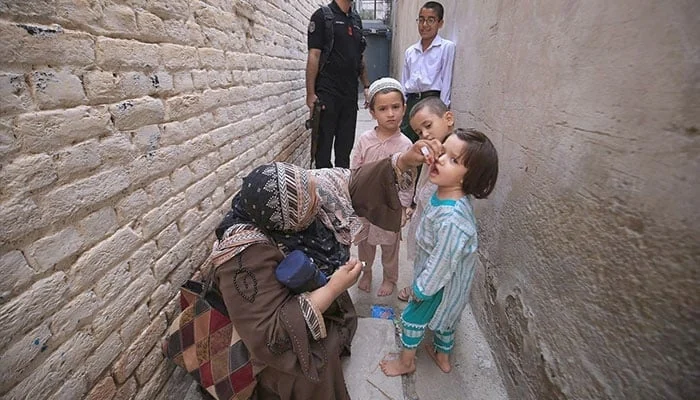
Amid the growing concern, Pakistan is continuing its nationwide door-to-door polio vaccination campaign.
The ongoing campaign covers 97 districts, including Khyber, with the objective of immunising nearly 24 million children.
Vaccination teams are visiting households to administer polio drops to children and ensure that vulnerable communities are not left behind.
In addition to the nationwide campaign, authorities conducted a targeted injectable polio vaccination drive in 78 union councils of the Peshawar Block between October 26 and October 31.
According to the Pakistan Polio Eradication Initiative, this targeted campaign protected approximately 829,000 children up to the age of 10.
The additional vaccination effort is particularly important for areas where environmental surveillance and reported infections indicate continued virus circulation.
Pakistan and Afghanistan are also conducting coordinated vaccination activities as part of their broader efforts to stop cross-border transmission. Polio Free Pakistan
Prime Minister Shehbaz Sharif Orders Stronger Polio Eradication Strategy
Following the latest cases, Prime Minister Shehbaz Sharif has called for stronger coordination between the federal and provincial governments to accelerate Pakistan’s polio eradication efforts.
During a meeting reviewing the country’s progress, the prime minister expressed concern over the recent infections and directed relevant authorities to prepare a coordinated action plan within one week.
He also instructed the federal minister and minister of state for health, the health secretary and members of the polio eradication team to visit all four provinces.
These visits are intended to facilitate direct consultations with provincial chief ministers and chief secretaries, allowing authorities to identify challenges and improve the effectiveness of vaccination campaigns.
The prime minister also emphasised the importance of strengthening routine immunisation coverage, particularly in areas where polio cases have been reported.
He appreciated the efforts of frontline vaccination workers and law enforcement agencies, highlighting the importance of providing security and uninterrupted access to vaccination teams.
In several parts of KP, security challenges and difficult geographical conditions can complicate vaccination activities. Ensuring that health workers can safely reach every household remains a major part of the eradication strategy. Dawn
Why Polio Vaccination Remains Important for Pakistani Children
Polio is a highly infectious viral disease that primarily affects children under the age of five. It can attack the nervous system and cause permanent paralysis. In severe cases, the disease can also lead to death.
There is currently no cure for polio, but vaccination provides effective protection against the disease.
Repeated doses are important because they help build and strengthen a child’s immunity against the virus. Health authorities therefore encourage parents to ensure that children receive polio drops during every scheduled campaign, alongside completing their routine immunisation schedules.
According to the Pakistan Polio Eradication Initiative, vaccination has helped reduce polio cases in Pakistan by approximately 99.8 per cent compared with the estimated 20,000 annual cases recorded in the early 1990s.
However, the latest infections demonstrate that the country has not yet eliminated the virus.
The challenge is not limited to providing vaccines. Reaching children in remote communities, addressing misinformation, maintaining public confidence and ensuring uninterrupted vaccination activities are equally important.
Can Pakistan Become Polio-Free?
Pakistan has made considerable progress in reducing polio transmission over the past decades, but the latest figures show that the fight is far from over.
The nine cases reported in 2026, particularly the concentration of infections in Khyber Pakhtunkhwa, underline the importance of maintaining consistent vaccination coverage.
Cross-border transmission also means that Pakistan’s eradication efforts cannot be viewed independently of the situation in Afghanistan.
For now, the focus remains on reaching every child, strengthening routine immunisation and improving coordination between health authorities and local communities.
Ultimately, eliminating polio will require more than government campaigns. Parents, healthcare workers, community leaders and educational institutions all have a role to play.
Pakistan has made significant progress against polio, but every new case is a reminder that the country cannot afford to slow down its vaccination efforts.