
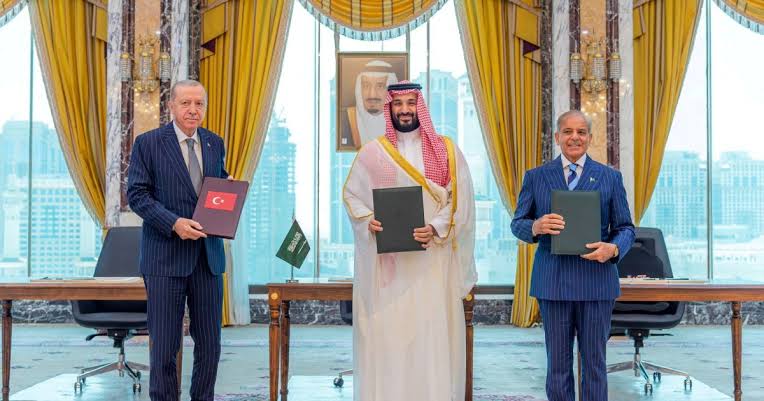
Pakistan, Saudi Arabia and Türkiye Set for Key Riyadh Talks Under Makkah Defence Pact
Pakistan, Saudi Arabia and Türkiye are set for a crucial meeting in Riyadh as senior political and military leadership from the three countries move to strengthen cooperation under the Makkah Joint Defence Agreement.
Deputy Prime Minister and Foreign Minister Ishaq Dar, Defence Minister Khawaja Asif and Chief of Defence Forces and Chief of Army Staff Field Marshal Syed Asim Munir are representing Pakistan at the meeting of the Strategic Political and Defence Committee (SPDC) in the Saudi capital.
The meeting comes at a particularly sensitive time for the region, with Saudi Arabia facing security challenges and the wider Middle East experiencing continued instability. The three countries are expected to review developments in the region and assess progress on cooperation under the Makkah Agreement.
Riyadh Meeting Brings Defence Leaders Together
The Strategic Political and Defence Committee meeting is bringing together foreign ministers, defence ministers and senior military commanders from Pakistan, Saudi Arabia and Türkiye.
According to Pakistan’s Foreign Office, the meeting will focus on the latest regional developments and ongoing cooperation under the framework of the Makkah Agreement.
Islamabad has described its participation as a demonstration of Pakistan’s continued commitment to regional peace and stability.
The presence of Field Marshal Asim Munir alongside the foreign and defence ministers also gives the meeting a significant military dimension. Rather than being limited to diplomatic consultations, the discussions are expected to examine how the three countries can translate their political commitments into stronger defence coordination.
Dar Arrives Ahead of Crucial Talks
Ishaq Dar arrived in Madinah before travelling to Riyadh for the SPDC meeting.
During his stay in Madinah, the deputy prime minister paid respects at Roza-e-Rasool and offered prayers for the peace and prosperity of Pakistan, the Muslim Ummah and the wider region.
He subsequently travelled to Riyadh, where he was scheduled to join Khawaja Asif and Field Marshal Asim Munir for the trilateral meeting with their Saudi and Turkish counterparts.
Why the Makkah Agreement Matters
The Makkah Joint Defence Agreement was signed by Pakistan, Saudi Arabia and Türkiye in Makkah on August 7, 2026.
The agreement created a framework for stronger collective defence, military cooperation and strategic coordination among the three countries.
One of its most significant provisions states that an armed attack against one member would be considered an attack against all three.
The agreement came after months of negotiations and amid growing security concerns across the Middle East.
For Saudi Arabia, the pact offers stronger defence cooperation with two countries that already have longstanding military relationships with the Kingdom. For Pakistan and Türkiye, it provides another platform for strategic cooperation and regional security coordination.
From Agreement to Alliance
The agreement has already moved beyond the signing stage.
At the first meeting of the Strategic Political and Defence Committee in Istanbul on August 31, the three countries agreed to further institutionalise their cooperation.
They also agreed to establish a permanent secretariat in Riyadh, with Pakistan initially set to head the secretariat for three years.
The three countries have also discussed strengthening military capabilities, defence-industry cooperation, joint technology development and production, intelligence sharing and greater coordination between their armed forces.
The arrangement was subsequently described as the Makkah Defence Alliance, underlining the effort to build a more structured trilateral security partnership.
Saudi Security Situation Adds Urgency
The Riyadh meeting is taking place against the backdrop of security concerns affecting Saudi Arabia.
Recent attacks targeting Saudi territory and infrastructure have increased the importance of the Makkah Agreement’s collective-defence provisions.
A previous meeting of the three countries’ military chiefs in Riyadh on September 25 focused on threats facing Saudi Arabia.
The commanders strongly condemned attacks targeting Makkah as well as civilian and economic infrastructure. They also discussed intelligence sharing, military coordination and the integration of defence capabilities.
The latest political and defence committee meeting therefore comes at a time when the agreement is facing an early test.
Pakistan’s Role in the Emerging Defence Framework
Pakistan has positioned itself as an important partner in the trilateral security arrangement.
Islamabad already maintains decades-old defence ties with Saudi Arabia, including military training and security cooperation.
Pakistan also has an established defence relationship with Türkiye, covering areas such as military training, naval cooperation and defence production.
The Makkah Agreement brings these existing relationships into a broader three-country framework.
For Islamabad, the arrangement also provides an opportunity to strengthen its strategic role in the Gulf while continuing to emphasise regional peace and diplomatic engagement.
Defence Cooperation Could Expand
The three countries have previously discussed cooperation beyond traditional military coordination.
Their plans include greater defence-industry cooperation, joint technology development and production, military exercises and stronger institutional links between their armed forces.
Such cooperation could eventually create opportunities for Pakistan and Türkiye to expand defence exports and joint projects with Saudi Arabia.
The agreement therefore has both immediate security implications and longer-term strategic and economic dimensions.
Regional Peace Remains Part of the Agenda
While defence cooperation is at the heart of the Makkah Agreement, the three countries have repeatedly stressed that their partnership is defensive in nature.
The members have said they want to strengthen collective deterrence while supporting efforts toward de-escalation and peaceful solutions to regional crises.
That balance is particularly important for Pakistan, which has also been pursuing diplomatic efforts over wider conflicts in the Middle East.
Islamabad has repeatedly called for dialogue and restraint, while simultaneously reaffirming its commitment to Saudi Arabia’s security.
The Riyadh meeting therefore allows Pakistan to maintain both tracks — strengthening strategic partnerships while continuing to promote diplomatic solutions.
What Could Come Out of the Riyadh Meeting?
The key question is how the three countries will further operationalise the Makkah Agreement.
The meeting could provide an opportunity to review the progress made since the pact was signed and discuss the next phase of military and political coordination.
The countries may also assess regional security threats, intelligence cooperation and mechanisms for responding to future challenges.
Although specific operational decisions have not been publicly announced, the presence of senior political and military leadership suggests that the discussions will carry considerable strategic weight.
A Test for the Makkah Defence Alliance
The Riyadh meeting represents an important step in turning the Makkah Agreement from a political commitment into a functioning security framework.
The earlier military commanders’ meeting demonstrated that the three countries were prepared to discuss Saudi security at the highest military level.
The latest SPDC meeting now brings the political and military dimensions together.
This could help establish clearer mechanisms for consultation and cooperation whenever one of the three countries faces a serious security challenge.
Pakistan’s Strategic Position Gains Attention
For Pakistan, the development comes at a time when Islamabad is seeking a stronger role in regional diplomacy while managing its own economic and security priorities.
Closer ties with Saudi Arabia and Türkiye could strengthen Pakistan’s strategic partnerships and create new avenues for defence and economic cooperation.
At the same time, Islamabad will need to carefully balance its commitments with its broader foreign-policy objectives, particularly its emphasis on avoiding further escalation in an already volatile region.
The Makkah Agreement gives Pakistan an additional platform through which it can engage with two key regional partners.
What Happens Next?
The Riyadh meeting is expected to provide further direction for the implementation of the Makkah Defence Alliance.
Pakistan, Saudi Arabia and Türkiye will review the current regional situation and assess cooperation under the agreement.
The establishment of the Riyadh-based secretariat, Pakistan’s role in initially heading that structure and the continued meetings between senior military officials indicate that the alliance is gradually developing an institutional framework.
For Pakistan, the immediate priority remains supporting Saudi Arabia’s security while advocating regional stability and peaceful resolution of conflicts.
Latest Update
As of October 5, 2026, Pakistan’s Deputy Prime Minister and Foreign Minister Ishaq Dar, Defence Minister Khawaja Asif and Chief of Defence Forces and Chief of Army Staff Field Marshal Syed Asim Munir are in Saudi Arabia for the Strategic Political and Defence Committee meeting under the Makkah Joint Defence Agreement.
The meeting brings together senior officials from Pakistan, Saudi Arabia and Türkiye to discuss regional developments and review ongoing cooperation under the agreement. Pakistan’s Foreign Office has said its participation reflects Islamabad’s resolve to contribute to regional peace and stability.
The Riyadh meeting could mark another important step in transforming the Makkah Agreement into a more coordinated and institutionalised regional defence partnership.