
AJK Unrest Takes Fresh Turn as Opposition Demands Accountability and Urgent Government Talks
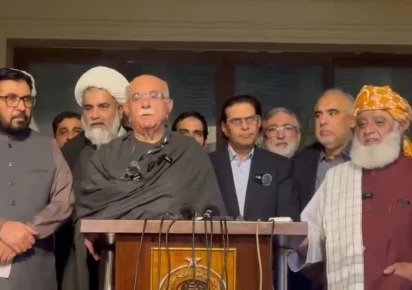
The situation in Azad Jammu and Kashmir (AJK) has drawn renewed political attention after the Tehreek Tahaffuz-e-Ain Pakistan (TTAP) called on authorities to stop further violence and return to negotiations with the Joint Awami Action Committee (JAAC). The opposition alliance raised concerns over reported casualties, restrictions on political representatives and the deteriorating security situation in Rawalakot.
The statement, issued on November 9, comes amid fresh tensions between security personnel and supporters of the JAAC. The developments have increased pressure on the regional administration to address public grievances while restoring law and order.
TTAP has argued that political disputes should be resolved through meaningful negotiations rather than force. The alliance has also demanded investigations into reported deaths, medical assistance for injured individuals and legal protection for people taken into custody.
TTAP Questions Restrictions on Political Representatives in AJK
One of the major concerns raised by TTAP involves the reported restriction of a political delegation travelling towards Azad Kashmir.
According to the opposition alliance, a senior delegation had planned to visit the affected areas to meet protesters, express solidarity with residents and assess the situation directly. However, its members were reportedly stopped at Kahuta and prevented from continuing their journey.
TTAP criticised the decision, arguing that political representatives should be allowed to meet affected communities and understand their concerns.
The alliance also questioned why its delegation was prevented from reaching the region and called on authorities to clarify the circumstances surrounding the incident.
It maintained that restricting political representatives from visiting affected areas could create further mistrust between the government and opposition groups.
Opposition Alliance Calls for Independent Investigation
Beyond demanding renewed negotiations, TTAP has called for an impartial investigation into the reported casualties and incidents involving security personnel and protesters.
The alliance wants authorities to ensure that the families of people reportedly killed during the unrest receive their bodies without unnecessary delays.
It has also demanded immediate medical assistance for injured individuals and legal protection for detained people.
Other demands include compensation for damage to public and private property, access for political representatives and an end to unnecessary arrests.
TTAP maintains that investigations should establish individual responsibility through transparent procedures rather than allowing allegations to go unexamined.
The alliance has further warned that continued confrontation could make the situation more difficult to resolve.
Sindh Rangers Personnel Dies Following Rawalakot Firing
Meanwhile, the security situation has also been affected by the death of a Sindh Rangers personnel who was injured during firing at an AJK police post in Rawalakot on November 5.
The deceased was identified as Naik Bostan Khan, a resident of Kohat district. According to an AJK Police spokesperson, he succumbed to his injuries on Sunday.
He had been deployed alongside AJK Police to assist local authorities in maintaining law and order.
Following his death, AJK Police expressed condolences to his family and acknowledged the sacrifices made by law enforcement personnel during their duties.
The police spokesperson also stated that individuals involved in attacks on security personnel would face legal action.
The incident highlights the continuing security challenges in Rawalakot, where tensions between law enforcement agencies and supporters of the protest movement have remained a concern.
JAAC Advisory Council Demands End to Firing and Restoration of Internet Services
The Advisory Council of the Jammu Kashmir Joint Awami Action Committee has also raised concerns over the situation in Rawalakot and surrounding areas.
The council called for an immediate end to firing and urged all parties to exercise restraint. It also stressed that peaceful demonstrations, freedom of expression and public participation should be protected.
Among its major demands are the restoration of mobile and internet services, access to medical facilities, legal assistance for detainees and a verified record of individuals taken into custody.
The council has also proposed forming an independent fact-finding delegation involving political representatives, lawyers, civil society members, journalists and human rights organisations.
According to its proposal, the delegation should visit affected areas, speak with residents and protesters, collect evidence and prepare an initial public report within 48 hours.
It has further suggested that government representatives and JAAC officials hold an initial meeting within 24 hours at a mutually agreed neutral location.
The proposed discussions would focus on establishing an agreed agenda, documenting decisions and setting clear deadlines for implementation.
What Is Behind the Continuing Unrest in Azad Kashmir?
The current situation is linked to a wider protest movement led by the Joint Awami Action Committee, which has been seeking constitutional, economic and administrative reforms in the region.
Its demands include removing 12 refugee-reserved seats from the AJK Legislative Assembly, reviewing the existing quota system and addressing privileges associated with the political elite.
The movement has also raised concerns about inflation, electricity prices, unemployment and the availability of basic public facilities.
Tensions increased after the AJK government proscribed the JAAC in June 2026, shortly before a planned long march towards Muzaffarabad.
Government officials maintained that 35 of the committee’s 38 demands had been accepted or implemented. However, authorities also accused elements associated with the movement of attacking government property and security personnel.
The government subsequently reinstated 177 FIRs against JAAC members on June 11, reversing concessions linked to an agreement reached in October 2025.
These developments contributed to an increasingly difficult relationship between the authorities and the protest movement.
HRCP Previously Warned Against Escalating Confrontation
The Human Rights Commission of Pakistan (HRCP) has also raised concerns about the continuing political and security situation in Azad Kashmir.
Following a fact-finding mission in August 2026, the organisation identified institutional distrust, restrictions on freedom of expression and communication, and the use of force as factors contributing to growing tensions.
The commission acknowledged that different parties had provided conflicting accounts of the incidents. However, it called for an independent investigation into reported deaths and injuries involving both protesters and security personnel.
HRCP also recommended inclusive political negotiations involving the JAAC, political parties and civil society representatives.
In a further statement on November 6, the organisation urged federal and AJK authorities to address public grievances through meaningful dialogue and provide journalists with unrestricted access to affected areas.
Its position reflects broader concerns about ensuring accountability, protecting fundamental rights and preventing further confrontation.
Political Dialogue Could Shape AJK’s Next Developments
The latest demands from TTAP and the JAAC Advisory Council have placed renewed attention on the need for negotiations in Azad Kashmir.
The situation involves several competing concerns, including public grievances, allegations of excessive force, attacks on security personnel and restrictions on political activities.
Resolving these issues will require verified investigations, access to affected communities and a process through which both sides can communicate their positions.
For the authorities, restoring public confidence while maintaining security remains an important challenge. For the protest movement, securing progress on outstanding demands through a peaceful political process remains central to its campaign.
As calls for negotiations continue, the coming discussions could play an important role in determining whether tensions in Rawalakot and other parts of AJK ease or continue.