
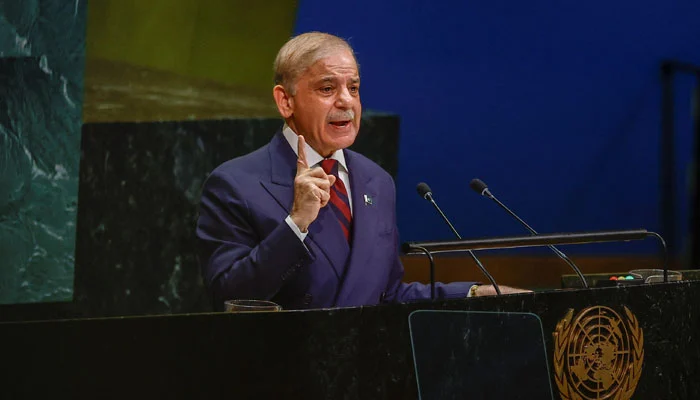
From Diplomacy to Investment: Shehbaz Sharif Highlights Key UNGA Gains for Pakistan
Prime Minister Shehbaz Sharif has described Pakistan’s engagements on the sidelines of the 81st United Nations General Assembly (UNGA) in New York as an important opportunity to advance the country’s diplomatic and economic interests.
During his visit, the prime minister held a series of high-level meetings with regional leaders, international financial institutions, European officials and business representatives. According to Shehbaz, the discussions focused on regional security, peace efforts, defence cooperation, economic reforms, investment and Pakistan’s international partnerships.
The visit came at a particularly sensitive time for the region, with tensions involving Iran, the United States and Israel continuing to shape diplomatic discussions. Pakistan used the UNGA platform to engage with several countries while also highlighting its economic priorities and efforts toward regional stability.
PM Shehbaz Focuses on Regional Security and Diplomacy
One of the major areas of discussion during Prime Minister Shehbaz Sharif’s UNGA engagements was regional security.
The premier met Iranian President Masoud Pezeshkian in New York, where the two leaders discussed the evolving regional situation and the need for dialogue and diplomatic engagement.
Shehbaz said Pakistan remained committed to supporting peace efforts and maintaining close communication with Iran. He also highlighted the importance of cooperation between neighbouring countries at a time when tensions in the region remain high.
Pakistan-Iran Dialogue Takes Centre Stage
Following his meeting with Pezeshkian, Shehbaz said the Iranian president had reaffirmed Tehran’s acceptance of the Islamabad Memorandum of Understanding (MoU).
The Pakistani prime minister said Islamabad would continue working to support peace and stability in the region.
The two sides also discussed bilateral relations and ways to strengthen cooperation in areas of mutual interest. Iranian officials, according to Pakistan’s Prime Minister’s Office, expressed interest in further strengthening relations with Islamabad.
The meeting was particularly significant because Pakistan has been seeking diplomatic engagement over the wider regional conflict and has repeatedly emphasised dialogue as a means of reducing tensions.
Makkah Defence Agreement Also Discussed
Regional defence cooperation was another important part of Pakistan’s UNGA diplomacy.
Prime Minister Shehbaz held trilateral discussions involving Saudi Arabia and Turkiye regarding the implementation of the Makkah Joint Defence Agreement (MJDA).
Pakistan, Saudi Arabia and Turkiye formalised their strategic relationship through the agreement on August 7. The framework is described by its proponents as a defensive arrangement aimed at strengthening coordination, military cooperation and regional stability.
During the UNGA meetings, officials discussed the next steps for implementing the agreement, including the development of institutional structures, committees and working groups.
Deputy Prime Minister and Foreign Minister Ishaq Dar also held separate meetings with his Saudi and Turkish counterparts to review progress on the arrangement.
Defence Cooperation Amid Regional Tensions
The discussions took place against the backdrop of heightened tensions across the Middle East.
The conflict involving Iran, the United States and Israel, along with attacks affecting countries in the region, has increased the focus on regional security and defence coordination.
Pakistan’s discussions with Saudi Arabia and Turkiye therefore formed part of a broader diplomatic effort focused on regional stability and security.
IMF Meeting Puts Pakistan’s Economy in Focus
Economic diplomacy was another major component of Prime Minister Shehbaz Sharif’s UNGA visit.
The prime minister met International Monetary Fund (IMF) Managing Director Kristalina Georgieva in New York and discussed Pakistan’s economic reform programme and the challenges facing the country.
Shehbaz said the IMF had expressed satisfaction with Pakistan’s implementation of reforms and had not raised serious concerns over the government’s targeted Rs100-per-litre fuel subsidy for lower-income consumers.
The subsidy is intended to provide relief to eligible consumers affected by higher petroleum prices.
IMF Acknowledges Reform Progress
Following the meeting, Georgieva said Pakistan’s strong implementation of reforms had helped preserve economic stability, restore confidence and regain market access.
She also said continued reforms would be important for boosting economic growth and improving living standards.
For Islamabad, the IMF engagement was significant because the government continues to balance economic reforms with measures aimed at protecting vulnerable sections of society.
The two sides also discussed Pakistan’s upcoming IMF programme review and continued cooperation on structural reforms and economic resilience.
Pakistan Highlights GSP+ Importance With EU
Pakistan’s economic relationship with the European Union was another key focus during the UNGA meetings.
Prime Minister Shehbaz met European Council President António Costa and European Commission President Ursula von der Leyen.
During the meeting, the prime minister highlighted the importance of the EU’s GSP+ trade framework for Pakistan’s exports, employment generation and economic development.
Pakistan also reaffirmed its commitment to strengthening its relationship with the European Union and implementing the Pakistan-EU Strategic Engagement Plan.
Why GSP+ Matters for Pakistan
GSP+ provides eligible developing countries with preferential access to the European market in exchange for commitments linked to international conventions covering areas such as human rights, labour rights, environmental protection and governance.
Pakistan is currently among the countries benefiting from the scheme.
The continuation of preferential market access beyond 2027 is therefore an important economic issue for Pakistani exporters.
According to reporting on the EU’s latest assessment, Pakistan has recorded significant exports to the bloc under preferential tariffs, while European officials have also raised compliance issues that Islamabad will need to address.
PM Invites US Businesses to Invest in Pakistan
Beyond diplomatic meetings, Shehbaz Sharif also used his New York visit to promote Pakistan as an investment destination.
The prime minister met Pakistani business personalities and professionals based in the United States and invited them to explore investment opportunities in Pakistan.
He highlighted sectors including information technology, artificial intelligence, agriculture, energy, construction and automobiles.
The government, according to the prime minister, is working to improve the business environment and address obstacles faced by investors.
Agriculture, IT and AI Among Investment Priorities
Pakistan’s agriculture and technology sectors featured prominently in the discussions.
Shehbaz highlighted measures aimed at promoting innovation in agriculture and improving the sector’s productivity.
The prime minister also pointed to opportunities in IT and artificial intelligence, reflecting the government’s broader push to attract investment into technology-driven industries.
The meetings were part of Pakistan’s effort to connect diplomatic engagement with economic opportunities.
Pakistan’s Diplomatic Role in Regional Peace
Pakistan’s diplomatic efforts also received attention from international figures during the UNGA week.
On September 26, Prince Rahim Aga Khan and UN Secretary-General António Guterres were reported to have acknowledged Pakistan’s regional peace efforts during separate meetings with Prime Minister Shehbaz Sharif.
According to the Prime Minister’s Office, Prince Rahim praised Shehbaz’s efforts for regional peace and stability at a time of heightened conflict in the region.
The recognition comes as Pakistan continues to position itself as a country seeking dialogue and diplomatic solutions to regional conflicts.
What Pakistan Took Away From the UNGA Visit
Prime Minister Shehbaz Sharif’s UNGA engagements covered several areas at once — from Iran and regional security to defence cooperation, IMF reforms, GSP+ trade and foreign investment.
The meetings also allowed Pakistan to engage directly with governments, international institutions and business communities at a time when the country is dealing with both regional security challenges and economic pressures.
While the long-term impact of these engagements will depend on follow-up actions and implementation, the discussions provided Islamabad with an opportunity to present its diplomatic and economic priorities on an international platform.
Latest Update
As of September 27, 2026, Prime Minister Shehbaz Sharif has described his UNGA engagements as important for advancing Pakistan’s diplomatic and economic interests.
His meetings included discussions with Iranian President Masoud Pezeshkian, Saudi and Turkish officials, IMF Managing Director Kristalina Georgieva, European Union leaders and Pakistani-American business representatives.
Regional peace, the Makkah Joint Defence Agreement, IMF reforms, GSP+ trade access and investment opportunities were among the key issues discussed during the visit.
The government is now expected to focus on translating these diplomatic discussions into concrete economic, security and regional cooperation initiatives.